

Sail design
From the hull's profile to behaviour on the water: how a Venti Sails sail is designed.
Venti aims to be at the cutting edge of technology, in both production and design. Our sails are born from the experience of our designers, backed by simulation data and advanced analysis methods. Engineering applied to sails makes our products a benchmark of excellence in sailmaking. Every sail is studied in its shape, its details and its finishes to be easy to use, durable over time, and always aimed at the highest possible performance.
Every Venti Sails sail starts with design work based on the boat's data – deck layout, rigging, speed polars – and ends with a three-dimensional profile optimised for the owner's real sailing conditions.
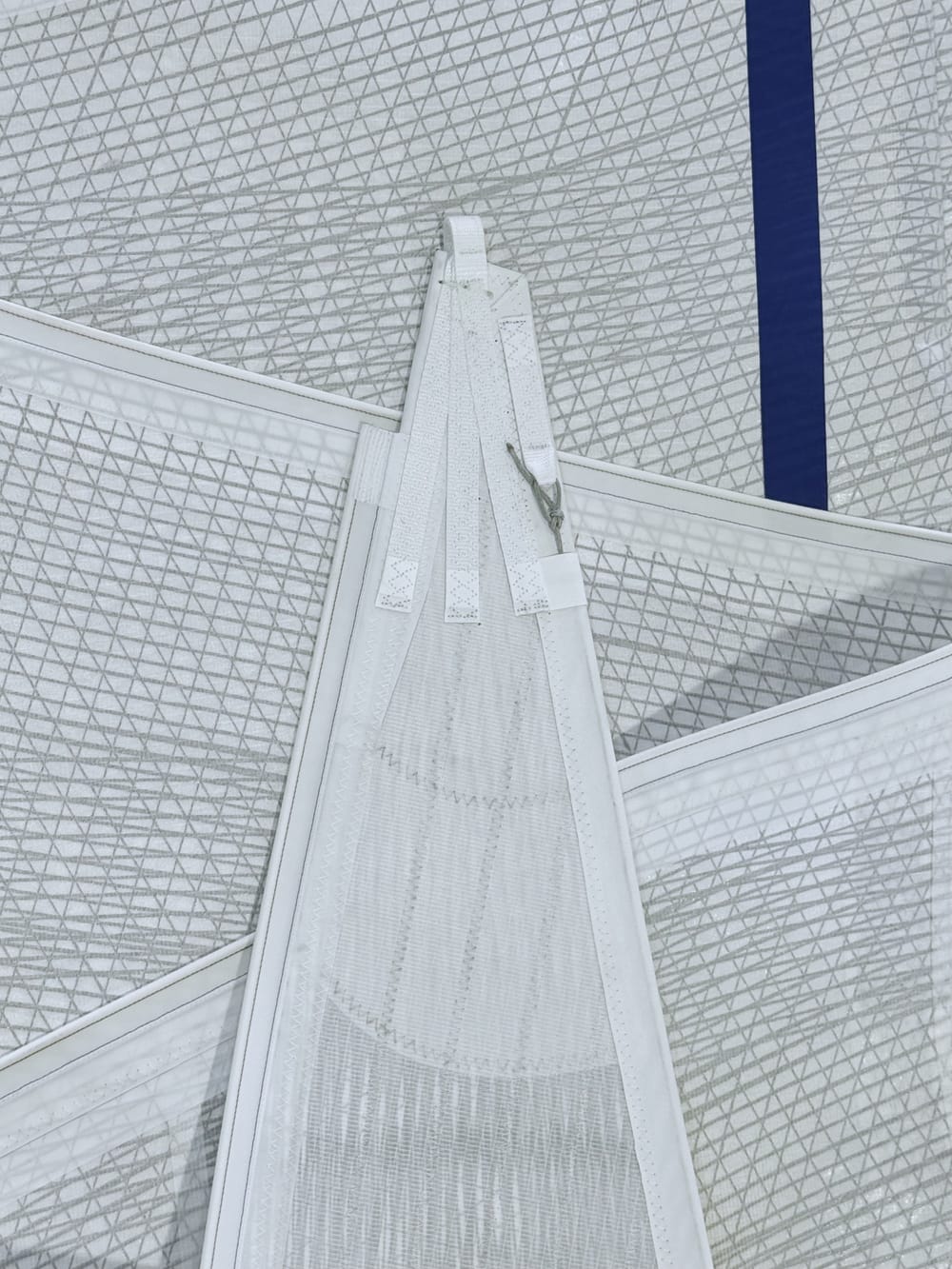
Shape design and choice of material go hand in hand: the sail's geometry and the layout of its fibres are worked out together, not one after the other, so the sail keeps its designed shape over time, even after thousands of miles of sailing.
From design to performance
-
Design
The design of our sails starts from measurements taken on board or from accurate sail plans. These data determine the size of the sail and some important details. The construction of the sail is designed to define the edge curves. The section shapes are then drawn to maximise performance. The structure and construction of the sail are designed taking into account materials, sailing conditions and the characteristics of the boat. Simulations help guide design decisions and optimise your boat's performance.
-
Sail shape
Every sail must perform not just in one particular condition, but across the widest possible range of conditions. Our sails are designed to maximise performance beyond ideal conditions alone, thanks to the right balance between three-dimensional shape, edge curve design and careful finishing.
-
Aerodynamic analysis
Our team of design engineers combines its experience with scientific simulation tools and a virtual wind tunnel. Designs are tested with our virtual tools, and decisions come from where experience meets calculation.
-
Structural analysis and fibre mapping
A sail is one with the rig it is paired with. Sail design cannot ignore how the rig and the sail material itself deform. Whenever we can, we simulate the deformation of the rig and analyse the deformation of the fabric, to be sure we deliver a sail that withstands the loads it is subjected to and whose shape lasts over time.
-
Performance optimisation
Studies in the virtual tunnel, besides providing valuable detail on the structure of the sails themselves, also produce performance data that can be compared with some handicap systems and passed directly to those working on performance optimisation, both when designing the boat and rig and when optimising it for cruising or racing.